
Beyond the Scale: Why Your “Weight” is Lying to You
Stop letting a single data point derail your progress. Here’s how to track the metrics that actually matter.


The Friday Morning Frustration
We’ve all been there. You’ve hit the gym four days this week, swapped the fries for a salad, and stayed hydrated. You step on the scale expecting a win, but the number hasn’t moved. Or worse—it went up.
Before you spiral into a “nothing is working” mindset, I have a reality check for you: The scale is a seductive but deeply flawed narrator.
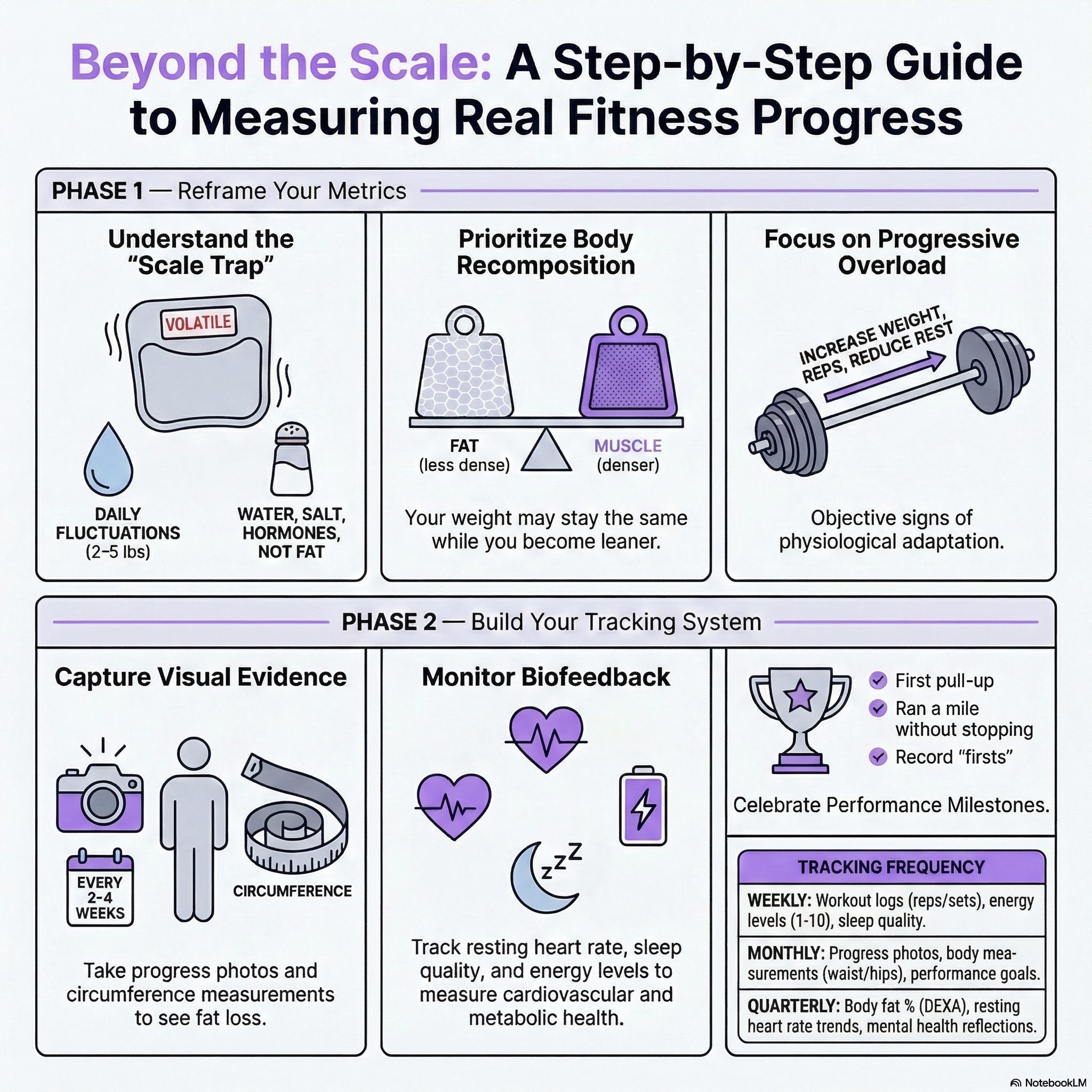
Your weight can fluctuate by 2 to 5 pounds in a single day based on:
Sodium intake (retaining water)
Hormonal cycles
Sleep quality
Inflammation from a tough workout
If you rely solely on the scale, you’re looking at a low-resolution photo of a high-definition journey.
The “Body Recomposition” Paradox
If you are strength training (and you should be!), you are likely experiencing body recomposition.
Muscle is significantly denser than fat. As you build lean tissue and lose adipose tissue, your weight might stay exactly the same, but your clothes fit differently, your energy levels spike, and your metabolic health transforms.
The scale can’t see muscle; it only sees gravity. ---
3 Better Ways to Track Your ROI (Return on Investment)
To build a sustainable fitness habit, you need to track what actually signals physiological change.
1. Strength Gains: The Ultimate Truth-Teller
Strength is an objective, measurable metric. If three months ago you struggled to squat 95 lbs and today you’re moving 145 lbs with ease, you have progressed. Period.
Watch for Progressive Overload: More reps, more weight, or shorter rest periods.
Celebrate Milestones: Your first pull-up or a faster mile time is a real adaptation that the scale ignores.
2. Composition Over Mass
Your body is a collection of systems (bone, water, muscle, fat). To see how those systems are shifting, use:
The “Jeans Test”: Are your pants looser in the waist but tighter in the quads? That’s fat loss and muscle gain in action.
Progress Photos: Take these every 2–4 weeks. The human eye can see definition and posture improvements that a digital readout cannot.
Circumference Measurements: Tracking your waist-to-hip ratio is a much better predictor of health than BMI.
3. Biofeedback: The “Quiet” Wins
Don’t ignore the data your body sends you every day:
Resting Heart Rate: A dropping RHR is a sign of an efficient cardiovascular system.
Recovery Speed: Are you less sore after leg day than you used to be? That’s your body becoming more resilient.
Mental Clarity: If your anxiety is down and your focus is up, your program is working.
The Multi-Metric Framework
The goal isn’t to overwhelm yourself with data, but to ensure no single “bad” day derails your confidence. Try this cadence:
Weekly: Log your workouts (reps/sets) and rate your sleep/energy.
Monthly: Take progress photos and waist measurements.
Quarterly: Check your Resting Heart Rate trends and reflect on your performance milestones.
The Bottom Line
The scale is a tool, not a judge. When you stop chasing an arbitrary number and start focusing on what your body can do, you stop “dieting” and start building a lifestyle.
What is one non-scale victory (NSV) you’ve had recently? Drop it in the comments below—let’s celebrate the progress that actually counts! 👇